
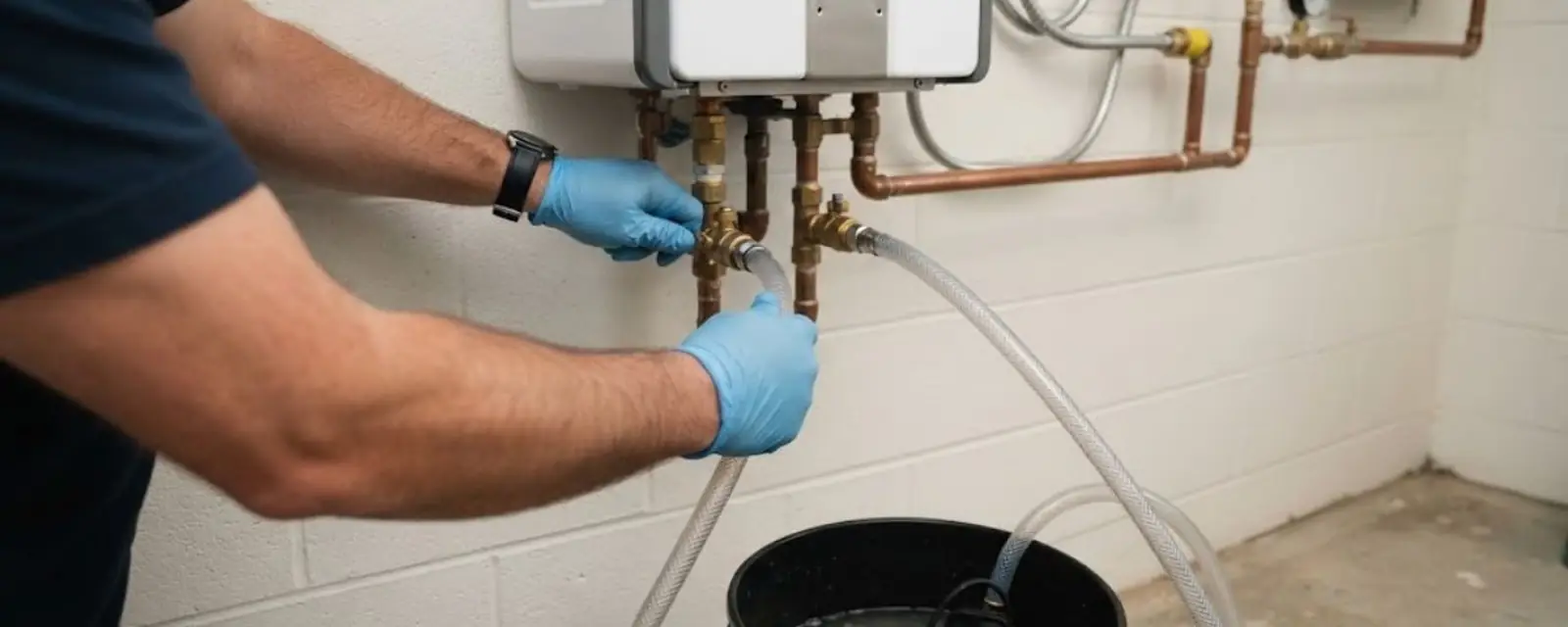
Why the filter matters
Most tankless heaters have a small screen where cold water enters. It catches sediment, rust flakes and debris before they reach the heat exchanger. When the screen clogs, flow drops, the unit may show an error code or the water runs lukewarm.
Cleaning the screen is routine maintenance, and it is often the first thing a technician checks. If your hot water has weakened, try this before calling. Our tankless water heater page covers service and installs.
How to clean the inlet filter
Check your model's manual first. Housing locations differ, and some units have extra filters.
Turn off power and gas
Switch the unit off at its power button or breaker and close the gas valve.
Close the water valves
Close the cold inlet and the hot outlet service valves, if the unit has them.
Relieve pressure
Open a hot tap to release pressure, and have a bucket and towels ready.
Remove the screen
Unscrew the filter housing at the cold inlet and pull out the screen.
Rinse and inspect
Rinse the screen under running water, brushing off debris with a soft brush. Replace it if it is torn.
Reassemble and restart
Put the screen back, open the valves, check for leaks, restore power and gas.
Filter cleaning or full flush
Cleaning the screen is quick and safe for most owners. A full flush needs a pump, hoses and a descaling solution, and many people hire it out.
| Task | How often | What it fixes |
|---|---|---|
| Clean the inlet screen | A few times a year, or when flow drops. | Weak flow and sediment blockages. |
| Flush the heat exchanger | Yearly, more often with hard water. | Scale that reduces heat transfer. |
| Check venting | Yearly. | Blocked or damaged flue. |
| Inspect combustion | Yearly by a plumber. | Safety and efficiency. |
| Check the condensate drain | Yearly. | Blocked or leaking condensate line. |
How to flush the heat exchanger
A flush uses a small pump, two hoses and a descaling solution, often white vinegar or a descaler made for the purpose. The pump circulates the solution through the heat exchanger for a set time, then the unit is rinsed with fresh water.
Follow your manual for the solution, the time and the valve positions. Many units have service ports for this. If yours does not, a plumber can add isolation valves. The flush removes scale that the filter screen cannot catch.
Do the flush yearly, or more often if you notice a drop in temperature or flow. After the flush, check the screen again and run hot water for several minutes to clear any remaining solution.
Hot water weak or lukewarm?
Call the 24/7 line. We will tell you whether it is a filter, scale or something else.
Scale, water and permits in Vernon Hills
Vernon Hills water comes from Lake Michigan through the Lake County Public Works system. The utility's report does not give a hardness number we would rely on, so test your tap to decide how often to flush. More scale means more frequent flushing.
The Village of Vernon Hills permit guide describes tankless units as not needing a permit, though it is a few years old, so confirm with the building department at 847-367-3700 before replacing a unit.
Source type: Lake County Public Works water quality report and Village of Vernon Hills permit guideWhen cleaning does not fix it
If the screen is clean and flow is still low, scale may be coating the heat exchanger. An error code may point to a venting, ignition or sensor problem. Do not keep resetting the unit.
Call for service if you smell gas, see leaks or see soot. Gas problems are an emergency. Leave the area and call your gas utility. For other issues, see our water heater repair page.
Safety notes before you open anything
Tankless heaters burn gas or draw large amounts of power. Turn off the gas and power before you open any housing. If you smell gas, do not touch switches, leave the building and call your gas utility from outside.
Water in the housing can be very hot if the unit has just run. Let it cool and wear gloves. If your unit is under warranty, check whether the manufacturer expects a licensed technician for certain tasks, because some warranties require it.
Making maintenance easier
Service valves on the inlet and outlet make flushing much easier. If your unit has none, ask a plumber to add them. A small sediment filter ahead of the heater can reduce screen clogs in homes where the water carries grit.
Keep a note of the date you clean the screen and flush the unit. A schedule helps you notice trends. Homes in Mundelein and nearby towns may see different water, so adjust the schedule.
Rules and guidance note
Follow the maker's guidelines for flushing and filter cleaning. Routine cleaning needs no permit, but replacing the unit does follow local rules, and the village permit guide says tankless units do not need a permit.
Illinois plumbers are licensed through IDPH, which offers a license lookup, so you can check anyone you hire.
Tankless filter questions
A few times a year, and whenever flow drops. Homes with sediment may need it more often.
Usually yes, with the unit off and the water closed. Follow your manual.
Scale or a sensor problem is likely. A flush or a service visit can find it.
The village's published guide describes them as not needing one. Confirm with the building department.
It can be, because scale builds on the heat exchanger. Test your tap and flush on a schedule.