
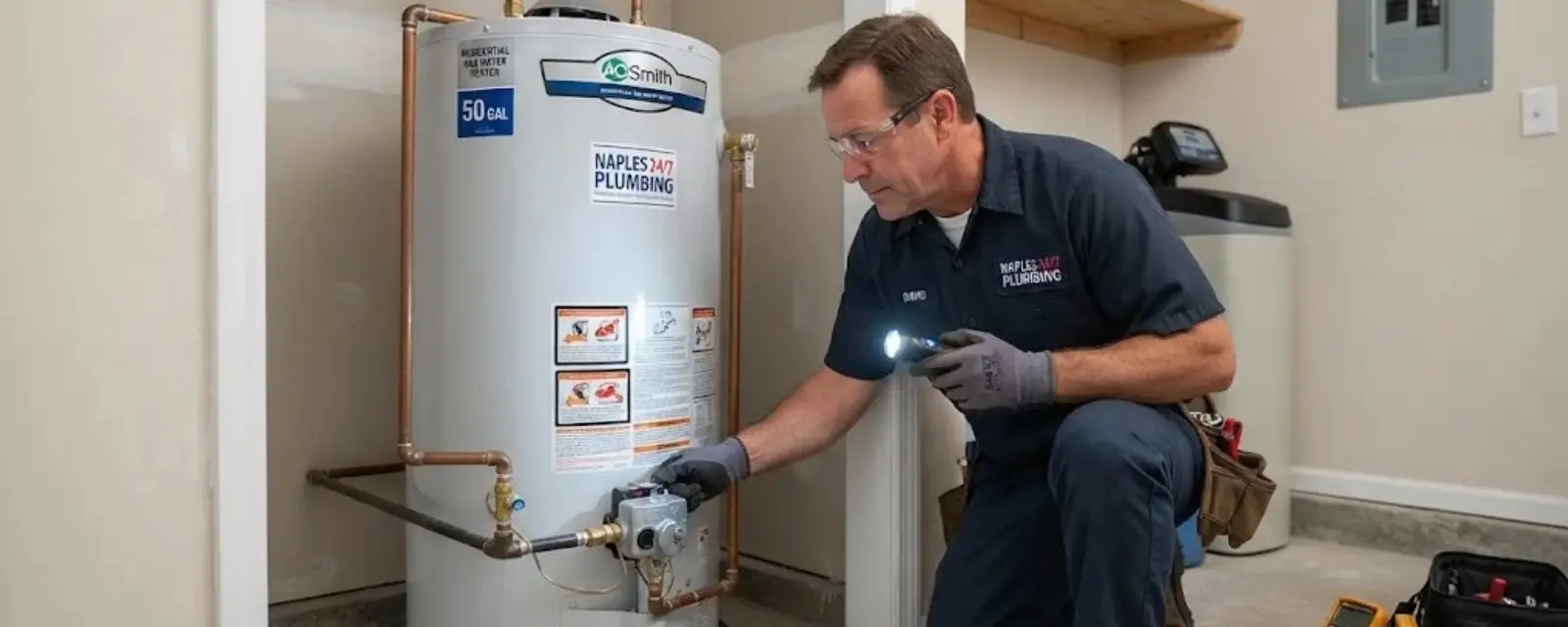
When a water heater failure is an emergency
Cold showers are an inconvenience. A tank that is actively leaking is different, because even a slow drip can soak drywall, flooring and stored boxes in a basement or garage by morning. If water is reaching the floor, close the cold supply valve above the heater and call right away.
Gas units add a second safety question. If you smell gas near the heater, leave the house and call 911 or your gas utility from outside before you call us. Our emergency plumber dispatch handles water heater failures at night and on weekends, and we ask a few questions on the phone so the right parts are on the truck.
Before the technician arrives
- Turn off the electricity at the breaker for an electric heater, or set the gas control to off for a gas heater.
- Close the cold-water shutoff on the pipe above the tank so it stops refilling.
- Open a hot tap upstairs to relieve pressure if the tank is leaking from the top.
- Move anything stored near the heater and put a towel or a wet-vac nearby, but never stand in standing water near an electric unit.
No hot water: what we check first
Most no-hot-water calls come down to a short list of parts. The cards below show how the symptom points to the likely cause. We confirm with a meter or a gauge before replacing anything, because guessing wastes your money.
Gas heaters
A pilot that will not stay lit, a worn thermocouple or flame sensor, or a gas control valve that has failed. Sooty or yellow flame points to a combustion or venting problem.
Electric heaters
A tripped breaker, a high-limit switch that needs a reset, or a burned-out upper or lower heating element. Thermostats fail too, and an element can short to ground.
Hot water that runs out fast
A broken dip tube mixes cold water into the top of the tank, and a failed lower element leaves you with half a tank of hot water.
Lukewarm or inconsistent water
Sediment on the burner or around the lower element, a mixing valve problem, or a recirculation pump issue in a home with a return line.
Leaking water heater: tank, fitting or valve?
A wet floor around a water heater is not always a dead tank. Condensation on a cold tank, a weeping drain valve, a loose supply connector and a temperature and pressure relief valve that is discharging can all leave a puddle. The tank itself is the only one of those that means replacement.
A technician traces the water to its source before deciding. If the leak comes from a fitting, a connector or a drain valve, it is a short repair. If water seeps through the steel shell or from the seam at the base, the tank has corroded through and no repair will hold, which is when our water heater replacement service makes more sense than another visit.
A relief valve that drips is a warning, not a defect to cap off. It opens when pressure or temperature climbs too high, so a repeat discharge often points to thermal expansion on a closed system, a failing thermostat or high incoming pressure. Capping the valve removes the last safety on the tank, so we find the cause instead.
Repair or replace: how we judge it
Honest advice sometimes means telling you not to spend money on an old tank. The age is on the rating plate, and the serial number usually encodes the month and year of manufacture.
Repair makes sense when
- The unit is under roughly eight years old and the tank is sound.
- The failed part is a thermostat, element, thermocouple or valve.
- Water quality has been managed and the anode rod is not depleted.
- The repair costs well under half of a new heater installed.
Replacement makes sense when
- The tank body is leaking or rusted through.
- The heater is past ten to twelve years and needs a major part.
- You have had two repairs in a short span.
- Venting or code items would need to be corrected anyway.
No hot water or a leaking tank?
Call the 24/7 line. We will ask a few questions and tell you whether this sounds like a quick repair or a replacement.
Popping, rumbling and rotten-egg smells
Popping or rumbling from a tank is usually sediment. Minerals settle on the bottom, trap water underneath, and the water flashes to steam as the burner or element heats it. A flush clears loose sediment, but a thick layer that has hardened may need descaling or a replacement.
A rotten-egg smell in hot water only is a chemistry issue inside the tank. Sulfate-reducing bacteria react with the magnesium anode rod and produce hydrogen sulfide gas. Replacing the anode rod, flushing the tank and sometimes disinfecting it often fixes the smell, and a powered anode is an option when the problem returns.
Rust-colored water from the hot side only is a sign the tank lining or anode has failed, while rust from both hot and cold points to old supply piping. Our repiping page covers what to do when the pipes are the real issue.
Gas, electric and heat pump models
The repair path depends on the type of heater. Gas units need combustion, gas pressure and draft checks, and a poorly vented heater is a carbon monoxide risk, so we test it before leaving. Electric units need a meter to test elements, thermostats and the high-limit, and they should be isolated at the breaker before anyone opens a panel.
Hybrid or heat pump water heaters have a compressor, a fan and a condensate drain on top of the electric elements. They also need open air space around them, so a heat pump unit in a tight closet may be failing from poor airflow rather than a bad part. We repair these when the fault is in the plumbing, wiring or elements, and we will tell you plainly if the repair needs the manufacturer.
A tankless unit has its own failure modes, from scale in the heat exchanger to error codes and flow sensor faults, so those are handled on our tankless water heater page.
Water quality in Vernon Hills and your heater
Vernon Hills water comes from Lake Michigan, treated at the Paul M. Neal Water Treatment Facility in Lake Bluff and delivered through Lake County Public Works. The annual water quality report we reviewed lists chlorine at about 1 ppm, fluoride at 0.6 ppm and lead results below the action level, but it does not list a hardness figure.
That matters because hardness sets how fast scale builds on elements and tank floors. Test your tap with an inexpensive strip kit or ask Lake County Public Works for its hardness number, then flush the tank each year if the water proves hard. If hard water is a recurring problem, our water softener and filtration page explains your options.
What a water heater repair costs
Repair costs follow the part, the unit and the time of the call. We give you a clear price before work starts, and if the right answer is a replacement we will say so and explain why.
Homeowners insurance often covers water damage from a sudden leak but not the heater itself or damage from a slow, long-running leak. Read the policy language, and document the failure with photos.
Code and permits note
According to the permit guide the village publishes, most repairs do not need a permit, but a repair that turns into a replacement does. The village permit guide, which cites the Illinois State Plumbing Code, covers that case.
Illinois plumbers are licensed through IDPH, which offers a license lookup, so you can check anyone you hire.
Water heater repair questions from Vernon Hills homeowners
Yes. Our line is answered 24 hours a day, including nights, weekends and holidays. A leaking tank or a gas smell gets priority, and we will walk you through shutting off the water and power while we dispatch. Same-day appointments are offered when available for no-hot-water calls that are not leaking.
Most tank heaters last somewhere around eight to twelve years, and water quality and maintenance change that. The rating plate shows the model and serial number, and the serial usually reveals the manufacture date.
A steady drip or a burst of water is not normal. The valve opens because pressure or temperature is too high, so the cause needs to be found. Never plug the discharge pipe.
If your water is hard, yes. Draining a few gallons from the tank clears loose sediment and slows scale buildup. A technician can do a full flush and check the anode rod while there.
We handle the plumbing, scale, flow and many electrical faults on both. Where a fault needs factory parts or a certified manufacturer technician, we say so before spending your money.
Permit rules vary by job, so the Village of Vernon Hills building department at 847-367-3700 is the place to confirm. Its published guide describes a permit for water heater replacement, which matters if a repair turns into a replacement.