
Why boilers fail when it gets cold
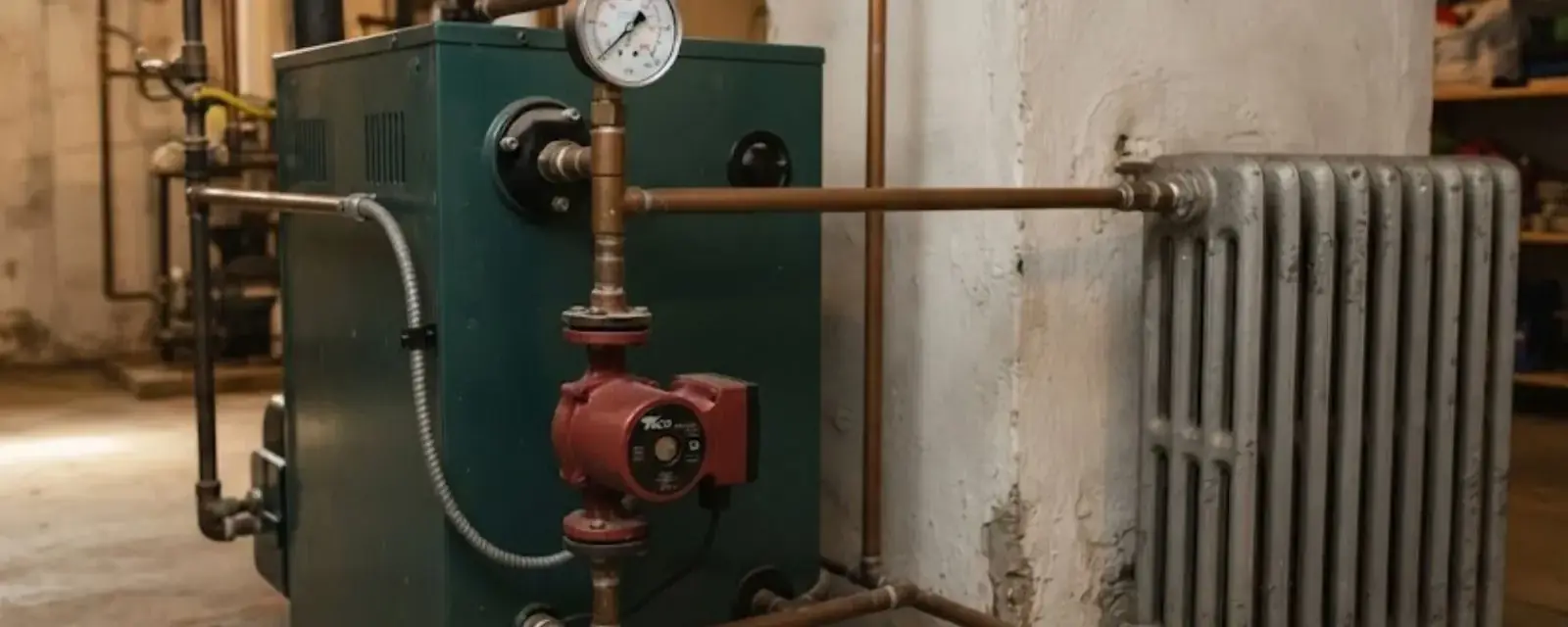
Northern Illinois winters push a boiler hard for months, and the failures tend to show up on the first deep freeze. A hydronic system heats water in the boiler, a circulator pump moves it through pipes, and radiators or baseboards release the heat. Any link in that chain can fail, and most calls come down to a short list of parts.
Hot water heat is common across northern Illinois, either as the only system or as a zone off a gas boiler. If your house has radiators, baseboard fin tubes, or a pipe running from a cast iron or steel boiler in the basement, this page applies to you.
Boiler symptoms and what they usually mean
Hot water heat is forgiving until one small part fails. The pattern of what is cold, what is noisy and what is wet tells a technician more than the brand label does.
No heat at all
A tripped switch or breaker, a thermostat call that never reaches the boiler, a failed igniter or flame sensor, or a lockout after a safety trip.
Heat in some rooms only
Air trapped in a loop, a stuck zone valve, a failed circulator, or a pipe blockage. Bleeding a radiator may fix a cold upper floor.
Banging, gurgling or kettling
Air in the lines, sediment in the boiler, or scale on the heat exchanger. Kettling sounds like a kettle about to boil.
Water on the floor
A weeping relief valve, a leaking pump flange, a failed expansion tank or a cracked section in an old boiler.
Pressure too low or too high
A cold boiler usually sits around 12 to 15 psi, so a gauge that drops to zero or climbs near 30 psi means a leak, an expansion tank problem or a faulty fill valve.
Short cycling
The boiler fires, shuts off, then fires again within minutes. Causes include an oversized unit, a dirty sensor, restricted flow or a thermostat fault.
How a boiler repair visit goes
Safety check
We check for gas odors, carbon monoxide, flue condition and obvious leaks before touching controls.
Read the system
Pressure, temperature, circulator operation, zone valves and the sequence of operation are tested in order.
Isolate the fault
We confirm the cause with test equipment rather than swapping parts.
Repair and verify
The part is replaced or repaired, the system is purged of air, and we confirm every zone heats before we leave.
Carbon monoxide is the real boiler hazard
A boiler that burns gas poorly produces carbon monoxide, which you cannot see or smell. Working CO alarms near sleeping areas are a basic safety step, and any alarm that sounds means leaving the house and calling 911. A technician also checks flue condition and draft as part of any repair.
No heat tonight?
Call the 24/7 line. We will talk through the symptoms and tell you what we can do and when.
Bleeding radiators, pressure and other things you can check
If a single radiator is cold at the top and warm at the bottom, trapped air is the usual reason. Turn off the circulator, open the bleed valve with a radiator key until water, not air, appears, then close it and check the pressure gauge. Top the boiler up if the pressure fell below its normal cold range.
Do not keep adding water if the pressure drops again within days. A boiler that loses pressure repeatedly has a leak or a failing expansion tank, and adding fresh water brings in more oxygen that corrodes the system. That is the moment to call.
Annual service before winter
A yearly service visit costs a fraction of an emergency in January. The technician checks combustion, cleans the burner and heat exchanger, tests the relief valve and the low-water cutoff, inspects the expansion tank and the circulator, and checks the flue and CO safety.
If your boiler also supplies domestic hot water through an indirect tank, we look at that coil, too. For a separate tank water heater, the water heater repair page covers what we check on those.
What we do not handle
We repair residential gas-fired hot water boilers. Steam boilers, large commercial plants and specialty systems may need a specialist, and we will say so on the phone rather than send a technician who cannot finish the job. For businesses with commercial heating, our commercial plumbing page lists what we cover.
What boiler repair costs
Boiler repair prices depend on the part and on how hard it is to reach. We give you a clear price before work starts and tell you honestly if the unit has reached the end of its life.
Insurance may cover water damage from a sudden leak, but not the boiler itself or damage from slow seepage, so document what you see.
Code and permits note
Boiler work involves gas, venting and pressure, so it is a good place to follow published guidelines and local rules. The Illinois State Plumbing Code that the village cites sets the baseline for the plumbing side.
If a repair becomes a replacement, ask the Village of Vernon Hills building department at 847-367-3700 what applies.
Boiler repair questions from Vernon Hills homeowners
Most residential hot water boilers sit around 12 to 15 psi when cold and rise a few pounds when hot. Your manual or the boiler's label gives the exact range, and a gauge that keeps dropping means a leak.
Air, sediment or scale are the usual causes, and low water flow can make it worse. A technician can purge air, flush the system and check the circulator.
Yes. Our line is answered 24/7. If you smell gas or a carbon monoxide alarm is sounding, leave the house and call 911 first, then call us.
Once a year before the heating season is the common recommendation. A visit includes combustion testing, cleaning and safety control checks.
Steam systems are a different specialty. We tell you on the phone whether we can handle yours before sending anyone.