
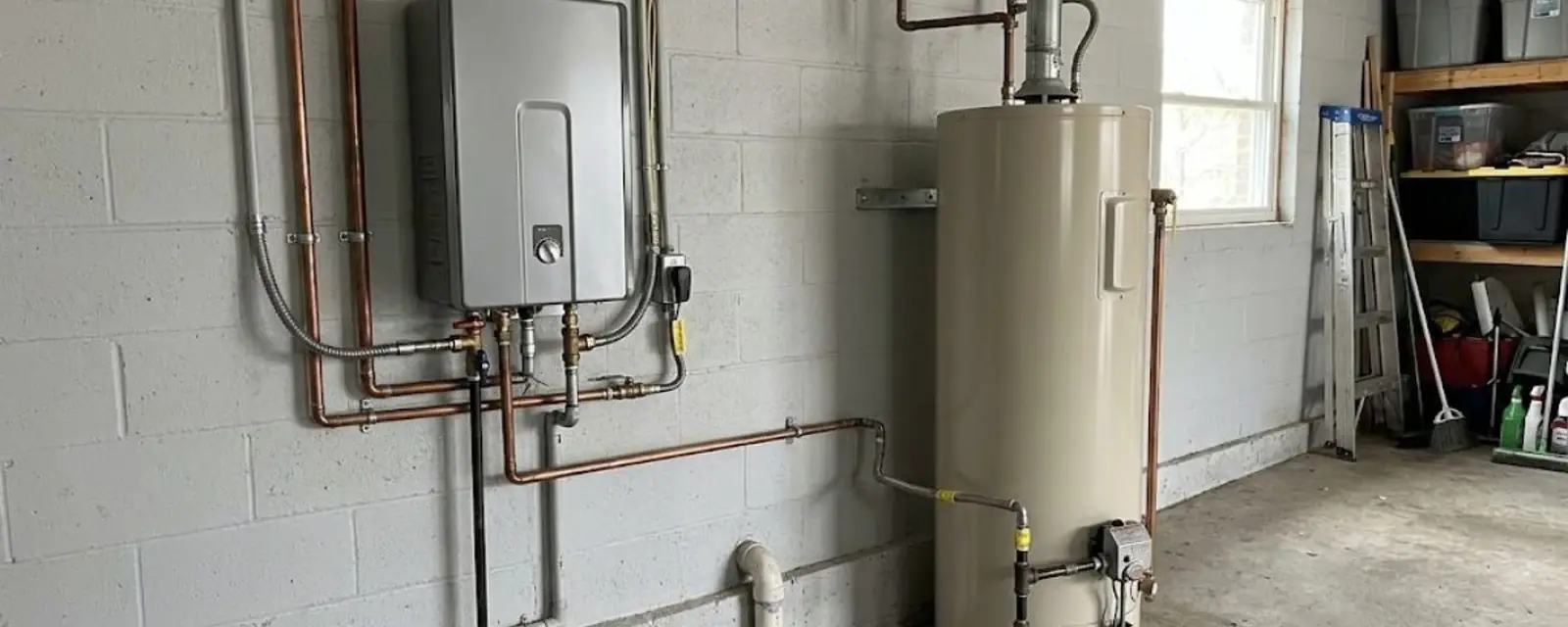
Three kinds of tankless calls
Most tankless calls fall into three groups. Some homeowners want a new unit installed and need to know whether the house can support one. Some have a unit that throws an error code, runs lukewarm or shuts off mid-shower. Many simply need a flush because the heat exchanger has scaled up after a few years of service.
We handle all three, and we do not send you elsewhere if the unit is not brand new. If your unit has failed past repair, our water heater replacement page explains how replacement works, including swapping to a tank or a heat pump model when that makes sense.
Flushing and descaling: the service most units are missing
A tankless heater has a narrow heat exchanger that is very sensitive to scale. Mineral deposits coat the inside, the unit has to work harder to move heat into the water, and sooner or later it overheats, loses flow or throws an error code. Yearly flushing is the manufacturer-recommended habit for most units, and hard water makes it more important.
A flush uses isolation valves on the unit's hot and cold lines so a small pump can circulate a descaling solution, usually white vinegar or a manufacturer-approved product, through the heat exchanger for roughly forty-five to sixty minutes. The technician then flushes the unit with clean water, cleans the inlet screen and checks the condensate drain on high-efficiency models.
If your unit has no isolation valves, we can add them. That one change makes every future flush faster and cheaper. Our water softener and filtration page covers the next step if scale keeps coming back quickly.
Symptoms we see, and what they usually mean
Callers describe tankless problems in everyday terms, and the description usually points straight to the cause.
Water runs lukewarm
Scale on the heat exchanger, a partially clogged inlet screen, or a flow rate below the unit's minimum. A mixing issue from a crossed cold and hot line also does this.
Error code and shutoff
Ignition faults, flame rod fouling, exhaust blockage and condensate drain clogs are common causes. The code narrows it, but it does not replace a test.
A short burst of cold water
The cold water sandwich. A small slug of cold water arrives between two hot water uses, and a recirculation setup or a buffer tank can reduce it.
Unit will not fire at low flow
Some tankless units need a minimum flow before they light, so a trickle at a sink may not trigger them. A flow sensor issue shows the same way.
Is a tankless heater right for your home?
A tankless unit heats water on demand, so it never runs out as long as the demand stays within its flow rating. That rating depends on how much the incoming water has to be warmed. In winter, when the supply is colder, the same unit delivers fewer gallons per minute than it does in summer, so sizing should assume the coldest months.
Gas models usually need a bigger gas line than a tank heater, because they burn fuel faster while they run. They also need a dedicated vent, either stainless or approved plastic pipe for condensing units, with a condensate drain. Electric models need heavy circuits and can overwhelm a small electrical panel. Those practical limits, not the unit price, decide whether tankless fits a given house.
Tankless or tank: a straight comparison
Neither choice is right for every household. A family of five with two showers running at once needs a bigger unit than a couple, and a basement with no floor drain has a different risk profile than a utility room.
Where a tank wins
- Lower purchase and installation price in most homes.
- Simple parts and a familiar repair path.
- No special gas line or venting upgrade in many houses.
- Works through a short power outage on gas models without electronics, depending on the design.
Where tankless wins
- Continuous hot water within the unit's flow limit.
- Compact wall-mounted footprint.
- Longer expected service life when flushed regularly.
- No standing tank to leak onto a basement floor.
Tankless unit acting up?
Call and describe the code or symptom. We will tell you whether it sounds like a flush, a part or a sizing problem.
Installing a tankless heater in Vernon Hills
Before quoting an install, we check the gas meter and line size, the vent route, the electrical outlet for the controls, the space on the wall and the water pressure. For a swap from a tank we also check the existing shutoff valves, the discharge path for the relief valve and the drain for condensate.
The Village of Vernon Hills' published permit guide says tankless water heaters do not need a permit, while it describes a permit and final inspection for tank replacement. The guide is a few years old, and installing a gas appliance can involve its own requirements, so we confirm the current rules with the building department at 847-367-3700 before starting.
Our related water heater installation page covers venting, code items and location planning, and the same checks apply to a tankless project.
What tankless service costs
A flush, a repair and an installation are very different jobs, and the cost depends on which one you need. We give you a clear price before work starts and explain what drives it.
Insurance does not pay for routine descaling. A sudden leak from a tankless unit may be covered as water damage, but not the unit itself.
Code and permits note
According to the village permit guide, a tankless unit needs no permit. It also says a tankless unit does not need a permit, while gas piping, venting and the relief valve still have to meet the Illinois State Plumbing Code that the guide cites.
The guide is a few years old, so confirm with the Village of Vernon Hills building department at 847-367-3700 before you buy.
Tankless water heater questions from Vernon Hills homeowners
Most manufacturers recommend yearly service, and sooner if the water is hard or the unit is lukewarm. Your manual gives the maker's schedule.
Yes. The small screen at the cold inlet catches debris and clogs more often than people expect, and cleaning it is part of every flush.
Yes. We diagnose and service units regardless of who installed them, and we tell you before spending money if a repair needs the manufacturer.
The Lake County Public Works water quality report we reviewed does not list hardness, so test your tap or ask the utility. Frequent scale or a short time between flushes suggests a softener would help.
Yes. Our line is answered 24 hours a day, and a unit that has stopped heating gets same-day attention when available. A gas smell is different. Leave the house and call 911 or your gas utility first.