
Decide what problem you are solving
People install a filter because of taste, smell, cloudiness, scale or worry about contaminants. Each calls for a different product. A carbon filter handles chlorine taste. Reverse osmosis handles dissolved solids. Neither fixes a corroded pipe that adds rust to the water.
That is why the first step is a test, not a purchase. A basic home kit or a lab test tells you what is in your water. Without it, you are guessing, and filters that do not match the problem waste money.
Kitchen filter types compared
Match the filter to the test result. If chlorine taste is the only complaint, a carbon filter is usually enough.
| Type | What it does | Trade-offs |
|---|---|---|
| Faucet-mount filter | Carbon cartridge on the spout reduces chlorine taste. | Low cost, slows flow, cartridges need regular replacement. |
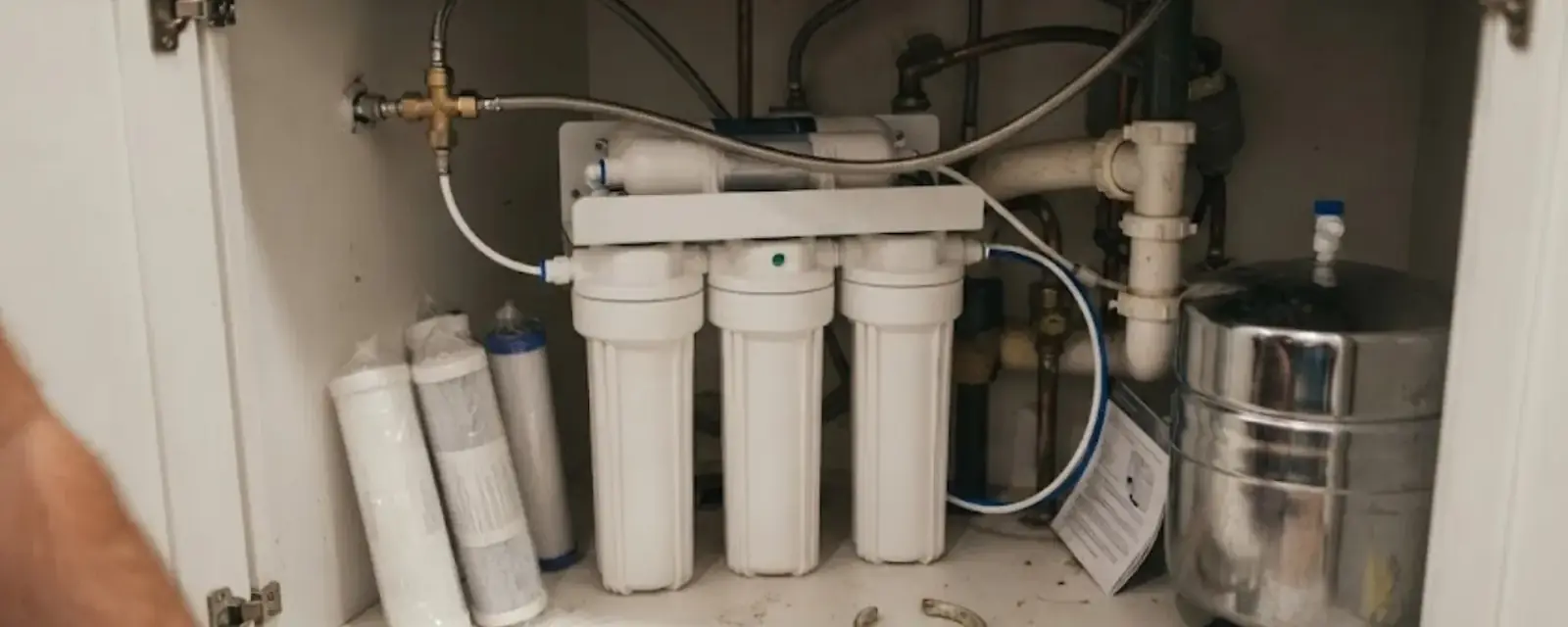
| Under-sink carbon filter | Dedicated tap or inline filter with a larger cartridge. | Better capacity than a faucet filter, needs space and a fitting. |
| Reverse osmosis | Membrane filters dissolved solids at a dedicated faucet. | Higher cost, wastes some water, needs a drain connection and a tank. |
| Pitcher filter | Carbon filter you fill by hand. | Cheapest and not installed, but small volume. |
How to test your tap
Home test kits measure hardness, chlorine, pH and sometimes iron or lead. They are not as accurate as a certified lab, but they point you in the right direction. For lead or bacteria, use a state-certified lab.
Test the cold kitchen tap after letting it run for a minute, then again after the water has sat overnight. If the second result is different, the plumbing in the house is adding something. Write down the results so you can compare after any filter is installed.
A test also helps you avoid products you do not need. Many people buy a whole-house system when a small under-sink filter would solve the one thing that bothers them.
What an installer actually does
Installation involves tapping the cold line under the sink, mounting the filter housing and, for reverse osmosis, connecting the drain and a dedicated faucet. A good job is leak-free and leaves a shutoff so you can service the filter without turning off the house.
Replacement cartridges and membranes are the ongoing cost. Set a reminder, because a spent filter can do more harm than none. Our water softener and filtration page describes the systems we install and service, and our plumbing installation page covers new fixtures.
Want help choosing?
Call and tell us what you notice at the tap. We will suggest a test and the simplest fix.
What the Vernon Hills water report says
Vernon Hills water comes from Lake Michigan through the Paul M. Neal Water Treatment Facility in Lake Bluff and is delivered by Lake County Public Works. The utility's report lists chlorine at about 1 ppm, fluoride at 0.6 ppm and lead below the action level at the plant. It does not give a hardness value that we would rely on.
Lead in a home usually comes from old plumbing, not from the plant. Lake County Public Works is preparing a lead service line inventory, with a final plan due in April 2027. If lead is a concern, ask the utility and consider a lab test.
Source type: Lake County Public Works water quality report and lead service line inventory pageMaintenance that keeps a filter working
Every filter has a life. A carbon cartridge loses its ability to absorb chlorine and odors, and a reverse osmosis membrane fouls over time. Mark the install date on the housing and set a calendar reminder for the replacement.
Sanitize the housing when you change the cartridge and check the fittings for drips. A slow drip under a sink can ruin a cabinet floor. If you notice a change in taste or a drop in flow, change the cartridge early.
We can service filters we did not install. Call and tell us the model, and we will say whether parts are easy to get.
Filters, softeners and the rest of the house
A kitchen filter cleans one tap. If your concern is scale on fixtures and appliances, the answer is a softener at the main line. Our water softener and filtration page explains the difference.
If your cold water is rusty or low in pressure, the problem is the pipes, and repiping may be the real fix. Homes in Mundelein and neighboring towns get water from different suppliers, so check the local report.
Rules and guidance note
Look for filters certified to NSF/ANSI standards, a real set of published water treatment standards. Filters are not regulated the way water heaters are, but the connections still follow the Illinois State Plumbing Code. Lake County Public Works publishes a water quality report, which is the right place to learn what is in your tap water.
Illinois plumbers are licensed through IDPH, which offers a license lookup, so you can check anyone you hire.
Kitchen water filter questions
Not necessarily. The utility treats and tests the water. A filter helps if you dislike chlorine taste or want extra reduction. Test your tap to decide.
Only filters certified for lead do. Check the certification label and replace cartridges on time.
For drinking and cooking water, it can be. It costs more, wastes some water and needs maintenance.
Follow the manufacturer's schedule. Skipping changes reduces performance.
Lake Michigan, treated at the Paul M. Neal Water Treatment Facility in Lake Bluff and delivered by Lake County Public Works.